
Heron Tower, London
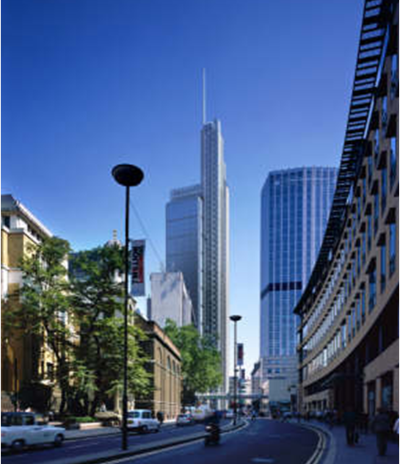
The building is one of the tallest in the City of London. The 47-storey tower rises to 203m in height, with a mast of 39m taking the highest point to 242m.
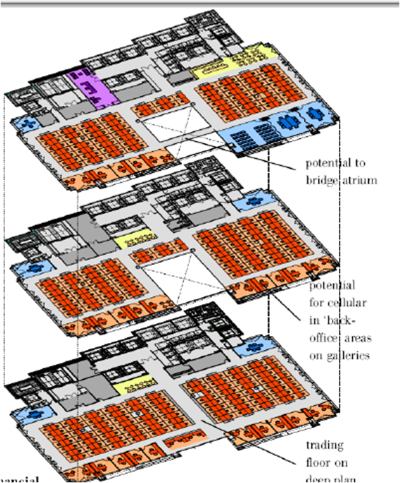
A key requirement of the architectural design was to maintain an open, interconnected feel to the building. This has been achieved by sub-dividing the tower into ten 3-storey villages, each with accommodation arranged around a central atrium.
Each 3-storey village is separated from the next by a 2-hour fire rated compartment floor, hence the principle behind the fire safety design is to treat each village as a 3-storey building connected by an open void. This leads to the requirement to assess multi-storey fires as part of the general fire safety strategy and for the structural fire protection of the building.
The building is also split vertically into two zones, with the accommodation and atria situated to the north of the building and the core zone containing combined fire fighting / escape stairs and plant rooms situated to the south.
The main superstructure of Heron Tower is a vierendeel stress tube that wraps around the perimeter of the office floors. The office floors are supported by long span (up to 14m) solid section Universal Beams acting compositely with a 130mm deep re-entrant deck.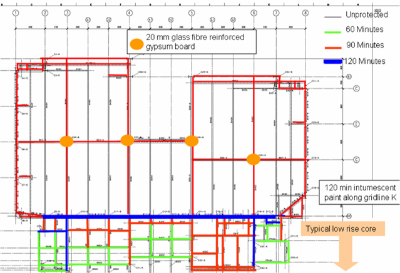
To demonstrate that this would provide an adequate level of protection, a finite element analysis was carried out using the commercial modelling program ABAQUS.
The first stage was to agree a reasonable design base fire scenario. A post-flashover fire on a single level only was proposed as being reasonable. However, due to the atria penetrating the normal floor to floor compartmentation, a multi-storey model with a less severe fire spreading to all floors was also considered and evaluated.
The models were then created giving a realistic representation of the structure including non-linear temperature dependant material properties, which are necessary to capture the kinds of large displacements seen in structures under fire load.
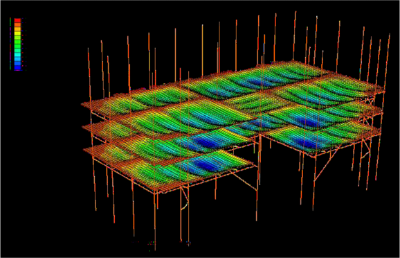
This is understood to have been the first building in the UK that was been approved using a multi-storey fire analysis as a fundamental part of the approvals process and is now widely seen as a benchmark for structural fire engineering in London.
To increase the lettability, the client wanted complete flexibility of the villages to allow tenants to either enclose the atria or leave them open to the accommodation. Because open atria would introduce a direct route for smoke to spread between levels, the fire safety design was developed using a simultaneous evacuation regime within each village, and ensuring that occupants on all parts of the floors can always escape away from the atrium in order to reach the escape cores.
The British Standards recommend that a smoke reservoir be provided in the top of the atrium to delay the time it takes for the smoke layer to build down to a level where it could spread back onto the upper floors and hence potentially affect escape. In this case, in order to create a suitable reservoir, it would have been necessary to separate the uppermost level of the atrium with smoke retarding construction.
However, to achieve the flexibility of open or enclosed atria desired by the client, Computational Fluid Dynamics (CFD) modelling was undertaken to demonstrate that occupant evacuation at the upper levels would not be compromised by the smoke spreading from a fire at one of the lower levels via the open sided atria.
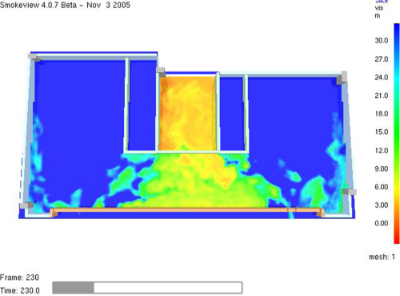
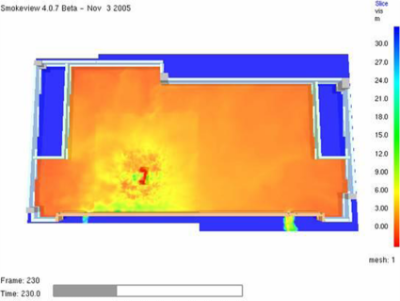
It was therefore demonstrated that the village concept would not compromise occupant life safety due to smoke spread, and that the design performed better than a possible code compliant arrangement.