
Snetterton Renewable Energy Centre, Norfolk
Straw power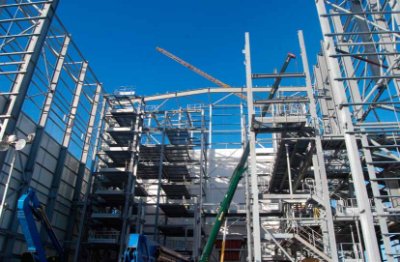
The latest straw powered biomass energy plant is under construction at Snetterton, Norfolk, close to the region’s main trunk road the A11.
Once operational in 2017, the plant will have an electrical capacity of 44.2MW, fuelled annually by 250,000 tonnes of baled straw supplied by local farmers, as well as woodchips. The plant is owned by a joint venture of Burmeister & Wain Scandinavian Contractor (BWSC) and a Danish infrastructure fund managed by Copenhagen Infrastructure Partners who together are investing around £160M in the project. It will be operated for 15 years by Danish company BWSC which is also managing the construction of the project
The biomass plant’s operation is based on energy technology developed in Denmark. The main part of the power plant is a boiler from Burmeister & Wain Energy (BWE), which is said to be the world’s largest water-cooled vibrating grate straw-fired boiler. BWSC has in the last three years completed a similar project in Sleaford, Lincolnshire (see NSC Sept/Oct 2013), and it is currently constructing another biomass plant in the same county at Brigg (see NSC June 2015).
Construction work on the Snetterton project got under way in February 2015, with BWSC clearing the greenfield site, stabilising the ground and installing slab foundations.
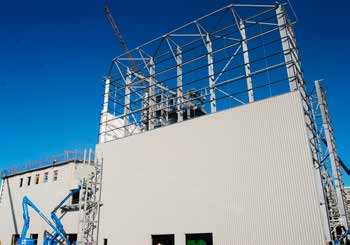
“Most of the access roads and slab foundations had already been completed when we started steel erection which made our work easier,” comments Caunton Engineering Site Manager Robert Aitman. “The roads allowed us to bring steel on to the site easily, while the slabs gave us a firm and flat surface for the cranes to be positioned on during the erection process.”
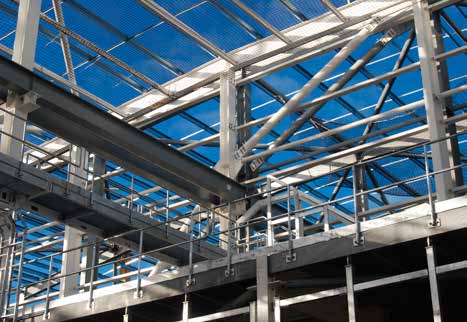
Caunton erected a portion of the boiler house first as this is a critical part of the overall scheme. By only erecting three sides of this large steel frame, a gap was left so that the boiler and all of its large ancillary equipment could be installed. “Once the installation work was completed, we then erected the fourth elevation and completed the roof over the boiler,” adds Mr Aitman.
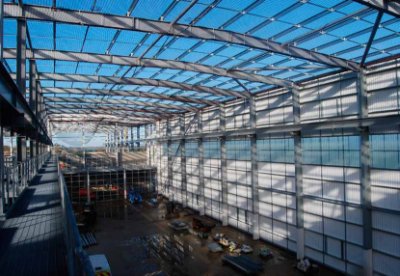
The building’s roof is formed by five 35m-long rafters, which arrived on site in 17.5m-long sections, each weighing 4t. Using two 50t-capacity mobile cranes, the roof rafters were lifted individually and bolted together in the air while being connected to the supporting columns.
During the boiler house steel erection sequence, Caunton also erected the adjacent turbine hall and a connected three-storey office annex. The turbine hall is a structurally independent building separated from the adjacent boiler house by a movement joint. Having the same width as the boiler house, albeit with a slightly lower roof, once clad the structures will look like one large building.
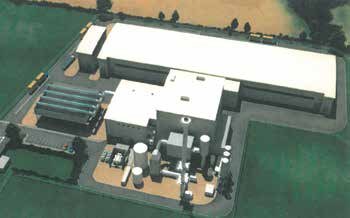
“While the boiler was being installed we began erecting the two conjoined straw barns,” explains Mr Aitman. “We had to work in coordination with the project’s concrete team who were still installing parts of the slab.” The two straw barns sit end-to-end and are structurally independent frames, separated by a row of double columns and a masonry blast wall.
Summing up BWSC Director Christian Grundtvig said: “We are delighted with the acquisition of the Snetterton plant which adds a strong base to our portfolio in the UK and we are looking forward to making it a successful project.”