
Ardross Distillery, Alness
Steel blend for distillery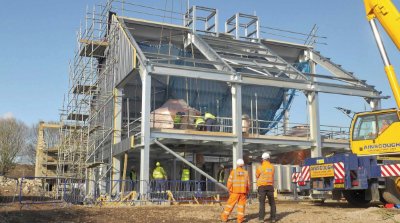
Set in the picturesque Averon Valley, some 30 miles north of Inverness, a new distillery is being built within the grounds of the abandoned and rundown 19th Century Ardross Mains farmstead.
The project’s client, Ardross Investments, purchased the site, which consists of 50 acres of private land with its own loch, in order to build a modern, state-of-the-art distillery that will produce a number of different spirits. To this end a steel-framed design that incorporates some retained and salvaged elements from the original buildings has been adopted as the most efficient construction method.
The main distillery building, containing the main entrance, still house, tun room, mash house and mill room, will be an L-shaped structure that partially surrounds an inner courtyard. The majority of this main building is a steel-framed structure, albeit with two original stone walls incorporated into the design and the area housing the main entrance and lobby which is timber- framed. The walls at the rear of the main building have been removed and rebuilt with a steel frame to increase the size of the new two-storey facility.
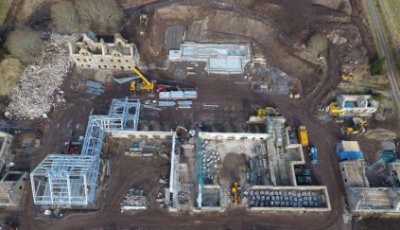
Steelwork contractor for the project is locally-based Mackay Steelwork & Cladding and it has erected 200t of structural steel for the main building and an adjacent boiler house. Also within the company’s remit is the supply and installation of metalwork, predominantly consisting of grating to form the distillery’s first floor, as well as stairs, hand railings, composite roof and wall cladding.
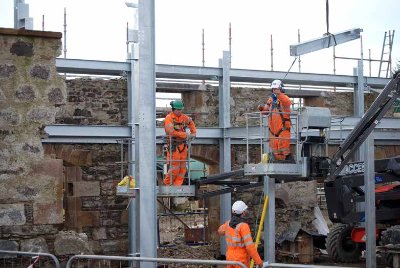
A steel-framed solution was chosen for its ease and speed of construction, as well as its ability to provide the column-free areas for the main building’s two floors. The steel columns are also carrying a considerable weight as the cladding will be topped with slate, and so the members are slightly larger sections than would ordinarily be used on a structure of this size.
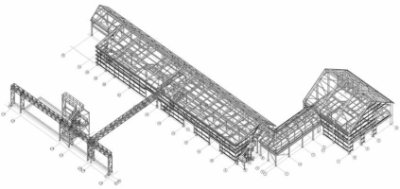
Using one 80t-capacity mobile crane for the steelwork, and a 55t-capacity crane for the cladding, Mackay completed the majority of its programme in six weeks. “The biggest challenge has been trying to co-ordinate all of our activities in a tight site, where most of the time we could only operate one mobile crane,” adds Mr Mackay. “At the same time, areas of roof steel and cladding had to be left out to allow installation of distilling stills and tanks. This happened during our construction phase and these areas of roof steel and cladding were then installed retrospectively.”
As well as the main distillery building, Mackay has also erected a pipe bridge that connects water tanks (known as the tank farm) with the distilling process within the mash house area, and a small steel-framed boiler house to the rear of the site.
Summing up, the Highland Council says that through the use of appropriate materials, with new sections of the building being sensitively sited and designed when viewed alongside the existing buildings, the project will safeguard the long-term future of the dilapidated historic buildings. In a report it concluded: “It is encouraging to see the future of the listed buildings protected and secured through a high-quality design, which respects the setting of the steading and the nearby Category A listed Ardross Castle.”