
SEGRO Logistics Park East Midlands Gateway
Eastern Gateway
A game-changing distribution hub (inland port) known as the East Midlands Gateway is under construction in Leicestershire. Covering 700 acres, the site combines links to the M1 and East Midlands Airport with a major new rail freight terminal. To facilitate this grand scheme, project developers Roxhill and SEGRO have also funded £100M of infrastructure, including a 50-acre rail terminal and extensive road improvements, designed to give the best possible connectivity to the 10 plots that will be available to occupiers.
SEGRO Chief Operating Officer Andy Gulliford says: “SEGRO Logistics Park East Midlands Gateway will be truly multi-modal: with its proximity to the M1 providing easy road access to the whole of the UK; the fact that it neighbours East Midlands Airport – the UK’s second largest freight airport – and that we are building a Strategic Freight Interchange as part of the scheme.”
East Midlands Gateway is located close to the very centre of England, with Nottingham 13 miles to the north-east, Leicester 20 miles to the south and Derby 14 miles to the north west. This is said to give it a strong, three city labour supply with one million people within a 30-minute drive, and 332,000 typical logistics employees within a 30-minute drive. The rail freight hub links directly to the Castle Donington freight line, which provides access to major UK ports such as Southampton, Felixstowe and London Gateway.
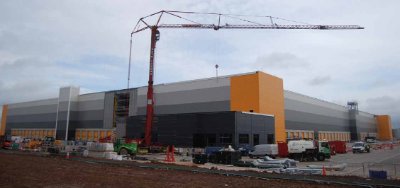
The three plots being erected by Severfield are all very large portal-framed structures with their own office blocks. Plot One, being built for an online retailer, requires 2,000t of structural steelwork for the main frame and then a further 4,500t for the building’s two internal mezzanine levels. The structure is the largest of the four under construction and measures just over 250m-long × 151m-wide and internally it consists of eight 31.6m spans. The structure also has an externally attached single storey office block running along one of its shorter elevations.
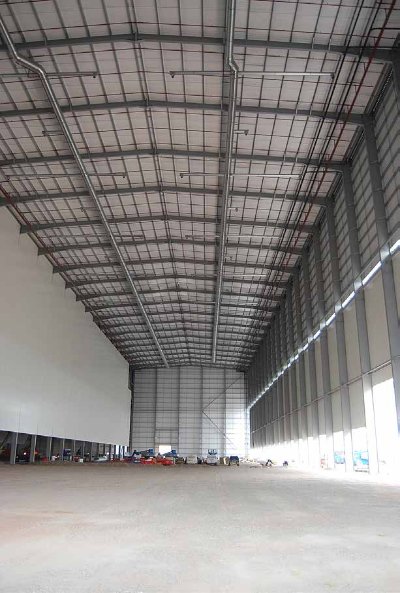
Lifting steelwork to a height of 35m is not a problem ordinarily, however as Severfield Site Manager Eric Wardle explains this is no ordinary site. “The structures are all being erected adjacent to the airport runway and so there is a crane height limit for safety reasons. When lifting in the roof steelwork for this plot our crane had to work within metres of the maximum allowed height.”
Situated along one corner, Plot Two has a 36.9m wide three-storey attached office. Unlike the offices in the other units, this one is not a solid structure as at ground floor level there is a 15m opening to let HGVs pass underneath. Beyond this opening, part of the office is cantilevered and in its final condition is supported by three pairs of forked feature columns. The 9m cantilevered floor beams had to be temporarily supported using 7m-high trestles during the erection. They were removed using a jacking system, once the steelwork was complete, to transfer the loads to the feature columns.
The third plot is the smallest of three Severfield distribution centres (46,451m2) and will be occupied by another online retailer. Up to 20m-high, the portal-framed structure requires 2,300t of steel. It consists of five spans, measuring 37.2m each and also has a two-storey office block attached to one gable end.
Steel bridge creates Gateway access
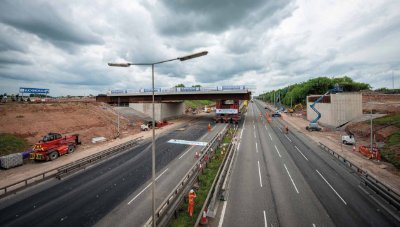
The bridge was delivered to site in four sets of braced girders, fabricated from weathering steel. The bridge span is approximately 50m, and the completed steel structure weighed approximately 330t. However, with the concrete deck added, the total bridge weighed close to 1,250t. The girders were assembled adjacent to the M1 motorway. The concrete deck was then cast by Buckingham Group onto the steel girders and, once sufficiently cured, the central supports were de-propped to allow the bridge to settle, prior to launching.
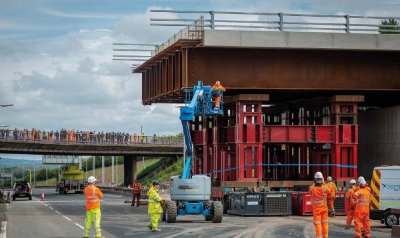
When the concrete had cured, Cleveland Bridge returned to site to install the entire bridge during a weekend closure of the M1 – limiting disruption to road users. A fleet of SPMTs was the preferred option to launch the structure into the final position. They lifted and manoeuvred the structure into place and then lowered it on to the abutments.
“We were extremely happy with the quality of the product supplied by Cleveland Bridge. They worked to a challenging programme and collaborated well throughout the project,” says Buckingham Group Project Manager David Lane.
EMG Plot Four
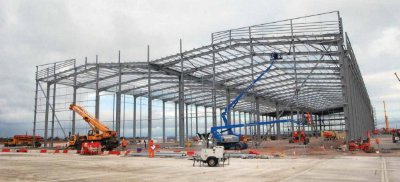
The structure has twin spans of 34.5m, supported by valley columns designed in a hit and double-miss configuration. “Many portal frames are designed with valley columns missing every other bay (hit and miss),” explains Caunton Engineering Project Engineer Julian Harrold. “On this frame design, we have gaps with two columns missing, as this was a client requirement to create more space for its racking systems.”
As the centrally-positioned spine beam has longer spans to bridge over, the member size changes in order to take into account the bigger loadings that are encountered on the top of each column. Thicker plate sections, measuring 400mm-wide and 8.5m-long, are positioned over the columns and these are then spliced to narrower 17m-long members that span between the columns. Supporting the spine beam is a series of plate girder columns each weighing 5t.
As well as designing and erecting the main frame, Caunton has also installed precast stairs within an attached three-storey office block, which is positioned along one of the gable ends, a pre-cast lift shaft and a walkway that connects the main office to a smaller hub office. The office block has a composite beam and column design, with internal clear spans of up to 10m. Caunton has subcontracted Structural Metal Decks (SMD) to install the steel decking.
At the opposite gable end to the office, the structure features a large 15m-deep loading canopy that stretches the entire 69m-width of the warehouse and is supported on a series of CHS columns. “Similar to the hub, we’ve erected the canopy late in the programme as these two external features would otherwise hinder the cladding installation,” says Caunton Engineering Deputy Erection Department Manager Richard Patterson. “Once the cladding was in place in these areas, we installed the canopy steelwork connecting to stubs that were left protruding and this then gave us a clean precise finish.”