
One Angel Court, London
Rebuilding a City towerS
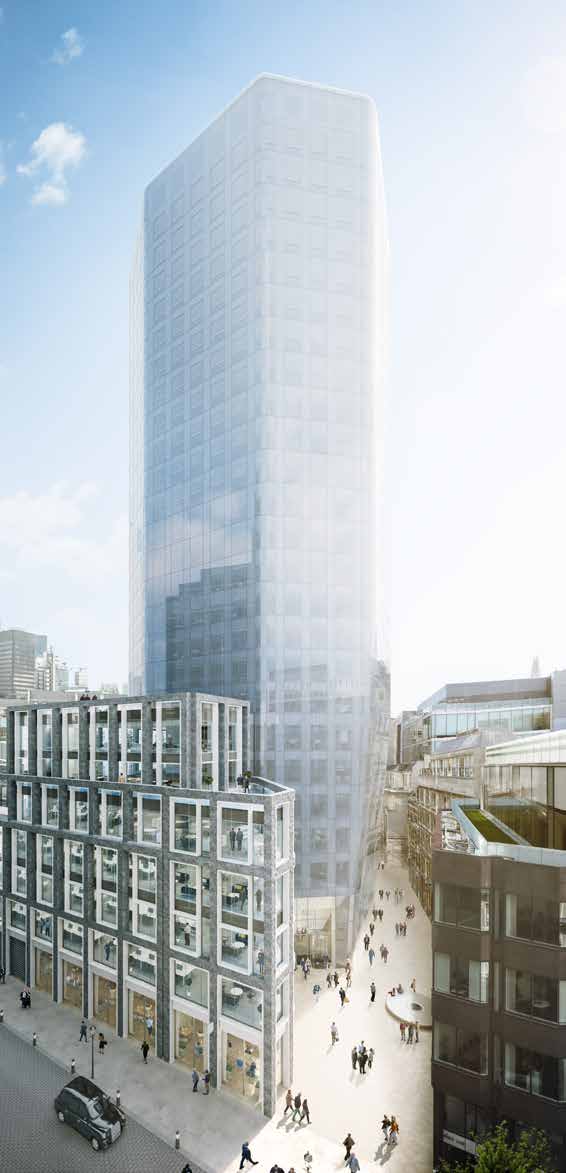
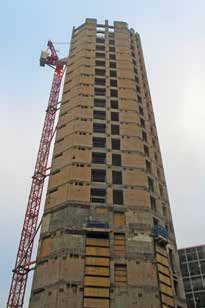
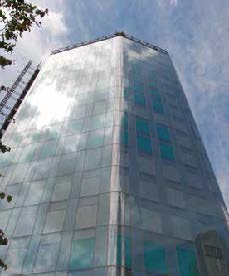
To help gain planning permission for a new office development within a City of London conservation area, a 24-storey concrete-framed building was demolished in 2014, with the exception of its centrally located core, which was retained so that a new structure could be built around it. With the core refurbished and heightened, a new steel-framed office block has risen up on the same spot providing 32,500m2 of floor space - 60% more than was previously available.
Replicating the original structure’s octagonal shape, One Angel Court incorporates two podiums, north and south, both in the same positions as the previous building’s podiums, but at seven storeys high these structures are higher.
According to Mace Project Manager for Structures, Marios Antoniades there are a number of reasons why the new tower and connecting podiums are steel-framed instead of concrete. “Steel has helped us achieve longer spans, have a quicker construction programme, add one additional floor and a double height plant enclosure to the top of the tower, while allowing us to re-use the existing core and foundations.”
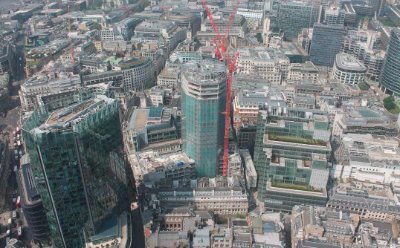
“We started the main steel erection with the tower as this is on the project’s critical path. Eventually we were working on three fronts once the podiums started,” explains Severfield Senior Project Manager David Managh.
From ground floor up to seventh floor, the tower’s columns are inclined, before straightening up for the upper floors. This means for the uppermost 17 levels, the tower is approximately 3m wider than the original building thereby increasing its available floor space. The tower features 9m clear spans from the centrally positioned core to the perimeter steelwork. Supporting composite metal decking the radial beams are 254UBs, while the perimeter members are slightly larger 525UBs.
Using a refurbished core within the tower presented a challenge for the steel erection. “Each floor had to be thoroughly surveyed prior to the steelwork being installed as the fixing plates were in slightly varying positions on each level because it was important to miss the core’s rebar when they were put in place,” says Mr Managh. “So although the beams are in the same arrangement each floor is slightly different.”
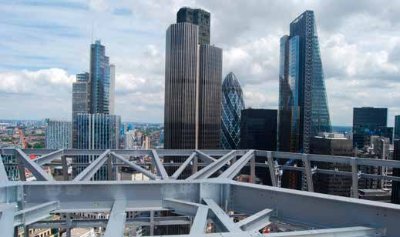
The most visually outstanding feature of the podium are the terraces, formed with steps in the steel frame at levels three, four and five, and the rooftop gardens. A series of 11t 500mm-deep fabricated beams was installed throughout both of the podiums to form these terraces.
The main entrance for the scheme is via a double-height space set back along the western elevation. This faces Angel Court, a previously narrow and dark passageway linking Copthall Avenue with Throgmorton Street. According to Fletcher Priest Architects, the development has added 30 per cent to the public realm turning Angel Court into an attractive pedestrian street lined with shops and restaurants, which catch midday sun, rather than a dark alleyway reached through a hole in the wall.
Completion of the project’s shell and core is scheduled for October, and the fit-out is then expected to be finished by the end of this year.
Some of the implications of inclined columns
By Dr Richard Henderson, SCI
The change in angle of the column at floor seven from inclined to vertical introduces a horizontal force at the intersection point which can be carried as an axial force in the floor beams assuming the intersection point occurs at floor level. The axial force includes permanent and variable components which are coincident with the vertical loads on the beams. The size of the axial forces depends on the slope of the inclined columns and a slope of 1.5m in 30m or 1 in 20 clearly results in a horizontal component which is 5% of the axial force in the column at this level. The axial force could be similar in magnitude to the shear force in the beam.
Tie forces are often specified as equal to the vertical shear force and therefore the axial force would also be similar to the tie force. The notable difference is that, unlike the tie force, the axial force and the shear force are present in the same load case. The normal rules set out in SCI publication P358 Joints in steel construction: Simple joints to Eurocode 3 therefore do not apply to these beam to column joints. Where floor beams connect to the inclined columns on intermediate floors, a small axial component is also developed in the beams due to permanent and variables loads.
In a building with a footprint of a higher degree of rotational symmetry than four (e.g. a hexagon), the horizontal forces at the floor level where the columns become inclined can be resisted as a hoop tension in the perimeter beams with no forces transferred across the building. In a square or rectangular building, the horizontal forces are balanced across the building and would need to be passed through or around the core. If the inclined columns are present on one side of the building only (or if the loads in the columns are not the same on both sides of the building), a net shear force from permanent and variable loads is applied to the building’s lateral load resisting system over the height where the columns are inclined. This shear force is conceptually similar to that resulting from sway imperfections dealt with in BS EN 1993-1-1 clause 5.3.2.
The presence of inclined columns introduces significant additional considerations which are not present in more conventional buildings.