The Royal Orthopaedic Hospital, Birmingham

A new £8m outpatients unit has been opened in 2011 at the Royal Orthopaedic Hospital in Birmingham. The new facility comprises an extension to the Out-patients Wing and includes 24 consultation rooms, treatment rooms and an ultrasound suite.
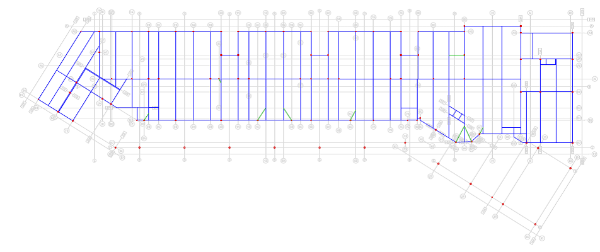
The two storey outpatients unit is approximately 75m long by 15m wide and comprises a steel frame with a 130mm deep composite steel deck for the floors. The building frame grid plan varies with maximum column spacing of 7.5m. Column sizes are typically 150mm square hollow sections and a maximum beam size of 610UKB. The layout of the first floor is shown in the figure below.
Floor vibration assessment
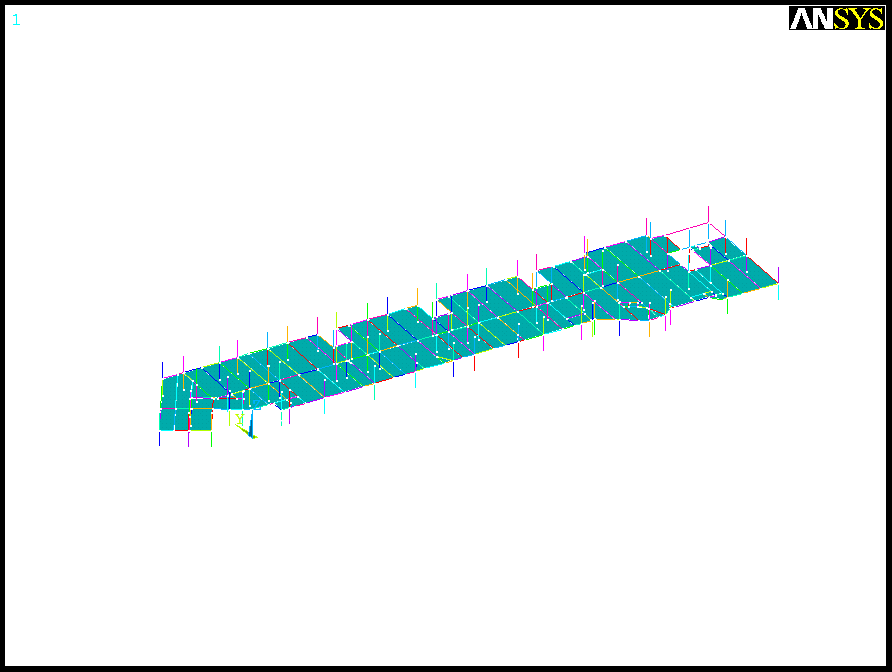
The floor area was modelled using 79 mm thick shell elements (i.e. the depth of the concrete above the SMD R51 profile) to represent the composite slab. The density of the material was adjusted to take account of the additional concrete in the troughs of the profile and the floor loading, and the stiffness was modified in one direction to represent the troughs of the deck. These shell elements were, in turn, connected to the nodes of the beam elements. In accordance with SCI P354[2], the dynamic Young’s modulus of the normal weight concrete was taken as 38 kN/mm2.
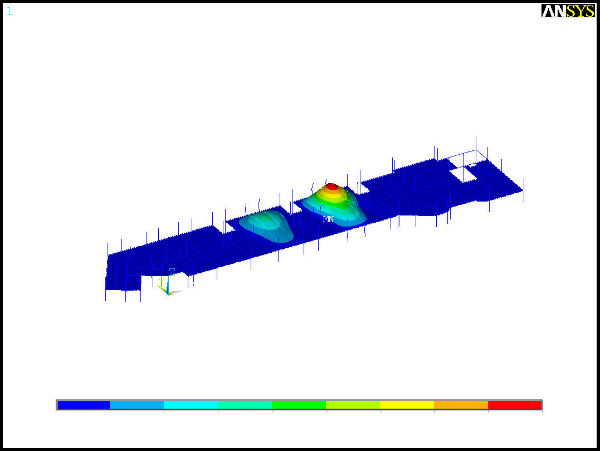
The beams were modelled using offset beam elements with rigid beam-to-column joints (although joints are designed to be pinned, for floor vibrations the strains are not large enough to overcome the friction and so pinned joints may be treated as fixed). The columns were pinned at their assumed inflexion points, located mid-height between the floors. Large voids for lift shafts and staircases were assumed to be rigid cores and so the surrounding steelwork was assumed to be fully fixed. The finite element model is presented in the figure below.
Current standards[3][4] describe human discomfort in terms of the perceived acceleration of the floor; floor suitability (in relation to vibration) is assessed by comparing the predicted acceleration with a set of defined acceptance criteria. Personal discomfort is recognised in the Standards[3][4] by applying multiplying factors to the acceptance criteria for different situations.
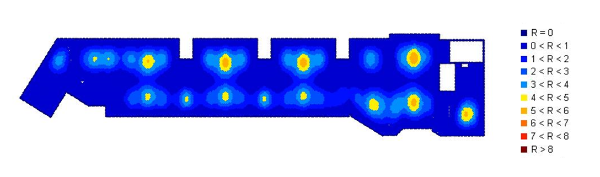
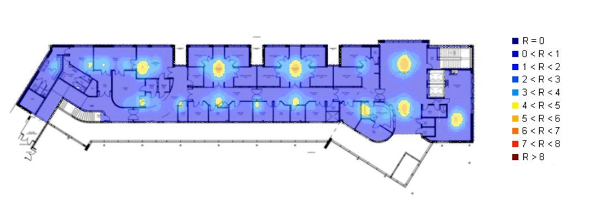
A dynamic analysis of the first floor of the New Out-Patients Unit was modelled using the ANSYS finite element software to determine the modal properties including natural frequencies modal mass and mode shapes. A modal superposition analysis was subsequently performed on the floor to determine the likely accelerations arising from walking activities based on the approach presented in section 6 in SCI Publication P354[2].