
University of Oxford Chemistry Teaching Laboratories
Top marks for steel frame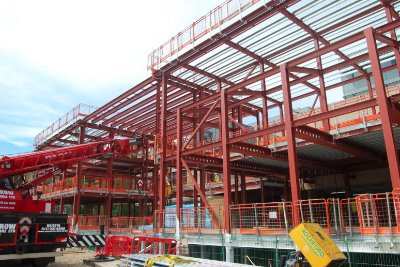
Oxford has been a seat of learning for nearly a thousand years and its university is regarded as the oldest university in the English-speaking world. Maintaining its position as one of the world’s top universities requires investment in its estate to provide students and researchers with cutting-edge teaching facilities. That’s exactly what has driven this latest project for the Department of Chemistry.
With available construction space at an absolute premium within Oxford University’s estate, the University hit upon the idea of creating a new build extension to an existing 1960s university building, incorporating underused space within this building to augment capacity. ISG is building a new three-storey steel-framed extension to create a suite of highly-specified undergraduate laboratories for the Department of Chemistry.
The existing structure is a 1960s-built concrete-framed building and a lot of design consultation was undertaken before deciding that a steel solution was the best option for the new extension. Although the steel frame ties into the adjoining existing structure, it is in fact structurally independent in terms of vertical load. “It is a fully braced frame down the length of the extension,” explains Four Bay Structures Senior Estimator Tony Wright. “It takes stability from the old building in the other direction.”
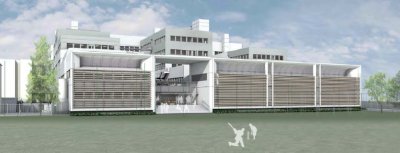
The extension is approximately 100m-long × 13m-wide, and comprises a partial basement, known as level A, with the laboratories situated above on level B and an enclosed plant zone and some offices on level C. Level A will link into the existing building in one area to create a prep room and equipment store. A glazed foyer and terrace with a louvred roof, which will also provide access into the existing building, divides the extension in two.
Once a series of 10m-deep piles had been installed, Four Bay Structures were able to begin the steel erection programme. It is a very confined site, bounded by the existing building on one side and playing fields on another. With very little room for manoeuvering or materials storage, Four Bay erected the steelwork sequentially, starting at the furthest point from the site’s road entrance.
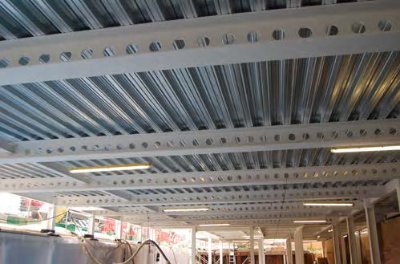
Steelwork is predominantly set out around a regular 7.5m × 12m grid pattern, using Westok cellular beams for the internal spans. “This is going to be a heavily serviced building, so cellular beams offered the most efficient solution,” says ISG Project Manager James Howard.
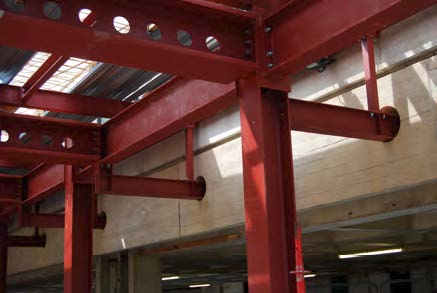
A double row of columns has been installed along the internal elevation, forming a passageway and supporting the beams that connect into the adjoining concrete structure, as well as ensuring that loads are not transferred into this older building.
The University of Oxford’s core focus on environmental sustainability has resulted in demanding targets of operational performance for the new build extension and refurbished elements in the existing building. ISG is targeting a BREEAM ‘Excellent’ rating for the new chemistry teaching laboratory. Sustainable measures include the installation of external solar shading, an extensive roof-mounted photovoltaic panel array, an advanced heat recovery system and connection into the university’s combined heat and power (CHP) district heating system.
The steel-framed extension is due to be complete by April 2018.