Comprehensive information on the subject was published in the 1980s in Reinstatement of Fire Damaged Iron and Steel Framed Structures[1]. The following text is a summary of some of the relevant information in that document.
Reasons for fire damage
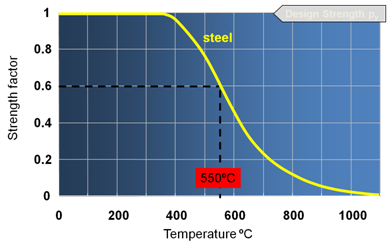
Behaviour of BS EN 10025[2] grade S275 steel
A grade S275, hot rolled structural steel section, subjected to fire conditions which causes its temperature to rise above 600°C, may suffer some deterioration in residual properties on cooling. In no situation however, irrespective of the fire temperature, will the room temperature yield stress or the tensile strength fall further than 10% below their original values. Thus, where it can be safely concluded that the steel members will be utilised to less than 90% of their maximum load bearing capacity or that any loss in strength will not bring the properties below the guaranteed minimum, replacement should not be considered necessary providing the member satisfies all other engineering requirements (e.g. straightness).
Behaviour of BS EN 10025[2] grade S355 steel
Grade S355, hot rolled structural steel also suffers losses in residual yield and tensile strength when subjected to temperature over 600°C in fire. High strength steels, of which Grade S355 is typical, obtain their characteristics as the result of the addition of strengthening elements, typically vanadium and niobium. At high temperatures these elements tend to precipitate out of the matrix creating a coarse distribution. As a result the reduction in yield strength at room temperature after the steel has been heated to temperatures above 600°C, may be up to 25%.
Connections and foundations
The tensile strength reduction for grade 4.6 bolts is similar to that for grade S275 steel. For grade 8.8 bolts, which are heat treated in manufacture, the residual strength reduction is more marked if the material temperature has exceeded 450°C. The residual strength of these bolts falls to 80% and 60% after reaching temperatures of 600°C and 800°C respectively. To err on the side of caution it is recommended that bolts should be replaced if they show any sign of having been heated e.g. blistered paint, smooth grey scaled surface.
Contraction of heated members after the fire can cause distortion of connections. When carrying out an inspection of a fire damaged building it is recommended that special care is taken in inspecting the connections for cracking of welds, end plate damage, bolt failure etc. A number of bolts should be removed to inspect for distortion. Similar care should be taken when inspecting foundations for bolt failure, concrete cracking etc.
Re-use of fire damaged steel
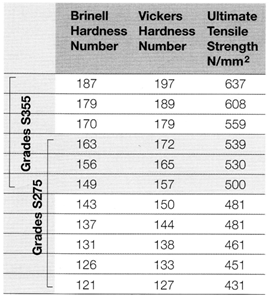
However, it is recommended that, in all cases, hardness tests should be carried out. For grade S275 steel, if the ultimate tensile strength resulting from the tests is within the range specified in the table, then the steel is probably reusable. For grade S355 steel additional tensile test coupons should be taken from fire affected high strength steel members when hardness tests show that:
- there is more than 10% difference in hardness compared to non-fire affected steelwork, or
- hardness test results indicate that the strength is within 10% of the specified minimum.
Where deflections are visible, general guidelines on the maximum permissible levels of deflection to ensure satisfactory performance are difficult to specify. The amount of deflection or distortion must be checked so that its effect under load can be calculated to ensure that the functioning of the structure is not impaired. Therefore every building should be considered as a separate case and the structural engineer involved in the reinstatement exercise must decide what level is acceptable to satisfy the relevant Codes.
Further reading
- Ingham, J: Forensic engineering of fire-damaged structures. Proceedings of the Institute of Civil Engineers. Civil Engineering 162. May 2009. Pages 12–17
- Maraeas, C; Fasoulakis, Z; Tsavdaridis, K: Post-fire assessment and reinstatement of steel structures. Journal of Structural Fire Engineering, Vol 8 No. 2, 2017