
Rushden Lakes, Northamptonshire
Lakeside centre shops for steel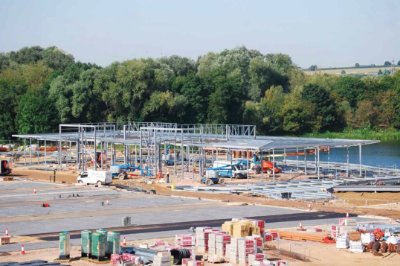
Shopping and nature may not necessarily go hand in hand, but a new development in Northamptonshire could change this perception, as it will offer retail outlets and leisure facilities situated on the banks of a lake set within a Site of Special Scientific Interest (SSSI).
Known as Rushden Lakes the scheme is centred around a series of man-made and natural lakes in the Nene Valley. Located on the busy A45 and it has been estimated that 600,000 people live within a 30-minute drive. Getting people to come will not be a problem as there will be plenty to occupy visitors including 30 retail outlets, a visitor centre and lakeside restaurants, while a boathouse will provide aquatic craft for hire. The adjacent SSSI will be integrated into the scheme with footpaths and cycle ways even extending to neighbouring tourist attractions.
Crown Estate Regional Portfolio Manager Hannah Milne says: “Rushden Lakes will be the first in a new generation of shopping parks, setting an entirely new standard for the retail and leisure experience offered by assets of this type. We will see occupiers coming to Rushden Lakes that have never traded out of town before, demonstrating the quality of the scheme.”
The retail outlets are all accommodated within three large steel-framed structures, known as Terrace A, B and C. The latter two buildings house the project’s three anchor stores, House of Fraser (HoF) in C and Marks & Spencer, and Primark in B.
Terrace C is the longest of the retail buildings at 196m with the two-storey HoF store accounting for approximately one-third of the structure. This block is a portal-framed building with steel columns – typically 305UC sections – spaced at 7m centres and supporting rafters that create two 26m-wide spans with the aid of one line of internal valley columns. Overlooking the scheme’s lake, the eastern end of the Terrace C (the part housing HoF) features a bull-nose rounded elevation. Steelwork has been facetted around a 66m radius to form this architectural feature. Attached to the HoF part of the building the portal-framed structure narrows down to a width of 37m (with two 18.5m-wide spans) to accommodate five more smaller retail units.
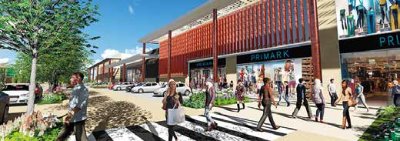
Terrace B is a 144m-long column and beam constructed building, gaining its stability from roof level bracing working in conjunction with the concrete floor that acts as a diaphragm. One end of the building, measuring 51m wide, accommodates a two-storey M&S store, where steelwork is based around a 9m × 9m grid pattern.
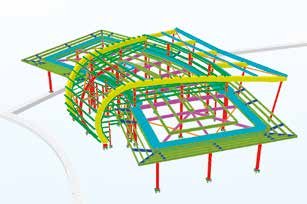
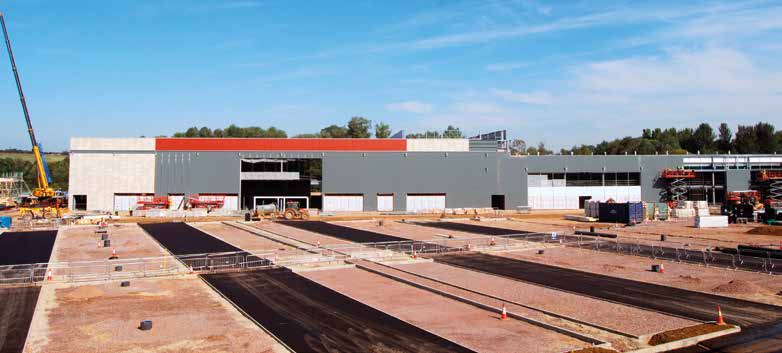
Caunton Engineering, who have been contracted on a design and build package for the terrace, boardwalk and restaurant steelwork, is due to complete on-site work this month (November) and the first retail outlets will be open early in the Spring.
Future plans at Rushden Lakes include two further phases, consisting of a steel-framed cinema complex and more retail units.
The Boardwalk
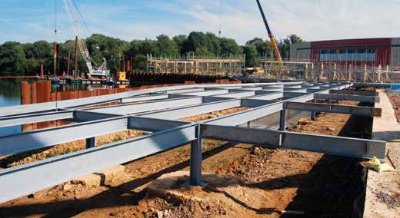
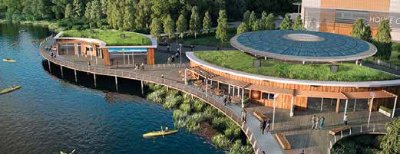
Caunton Engineering have also erected three steel-framed single storey restaurant blocks that overlook the lake and sit adjacent to the boardwalk structure.
Alternative framing arrangements
By David Brown, SCI
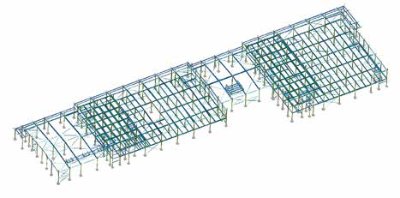
Despite their apparent simplicity, portal frames are relatively complicated structurally – their flexibility means that second-order effects are generally important and the potential for reversing bending moments mean that the restraints to the compression flange must be carefully considered. Comprehensive guidance is provided in P399. For maximum efficiency, frame design will be completed using software specifically developed for portal frames.
The moment resisting connections at the eaves and apex can also be complex, so the use of software to design these connections is highly recommended. Although portal frame structures are often designed by the Steelwork Contractor (as was the case at Rushden Lakes) engineers often need preliminary sizes and the look-up tables given in P399 for S355 steel can be very helpful. Designers should note that the preliminary sizes given in the earlier publication P252 are for S275 steel, which is no longer readily available in the UK.
Terrace B is a fully braced box, which is a useful reminder that other forms of steel construction can be an economic alternative to a portal frame. Terrace B includes extensive mezzanines, roof-mounted plant and a number of different spans, so the solution adopted was to provide plan bracing at the roof level and vertical bracing around the six commercial units that form the terrace. Rafters are simply supported beams. A fully braced box is a simple solution, amenable to manual design. The connections are nominally pinned, as found in the “Green Book” series of publications. The compact connections can be an advantage if space is limited and does not allow haunched moment-resisting joints.
The disadvantage of simply supported members is the increase in structural depth as the spans lengthen, but this can be managed by the use of fabricated members. Within Terrace B, ordinary rolled sections were used because the building layout allowed the use of intermediate columns, reducing the span of the beams. Second-order effects must still be assessed even in a braced box, though the calculation is simpler than the process for a portal frame. P365 demonstrates how to assess frame stability for a braced frame.