Ducie Court, Manchester
Meeting the student deadline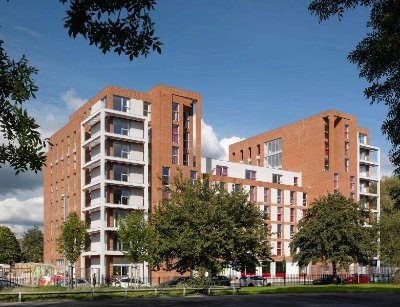
Text by Pamela Buxton, photos by Daniel Hopkinson
Delivering student housing is highly time sensitive. Miss the start of the university autumn term and you’ve lost a year’s potential rent. So speed really was of the essence at Ducie Court, a substantial 614-unit development of student accommodation in Manchester designed by Hodder & Partners.
While a swift construction was important, at the same time client Worthington Properties was keen to deliver a building with a sense of longevity, especially given the prominence of the site opposite Manchester’s grade II listed Whitworth Art Gallery. The result is a building designed with a steel frame for speed but with red brick cladding to give it a robust character. The first phase has been completed in time for the autumn term and is now fully occupied.
Hodder was initially asked by the then owner to convert the existing building on the site – a Victorian school turned homeless hostel – into residential accommodation to take advantage of the proximity to the university. Feeling that it would be a huge compromise to create appropriate provision within the context of the original building, the architects instead made the case for demolition and a new build. The site was subsequently sold to Worthington Properties, who specialise in student housing.
“We were very keen, having witnessed more recent student accommodation, to revert to a more traditional arrangement of buildings around a courtyard with the sense of community that Oxbridge precincts give,” says Stephen Hodder, whose practice designed acclaimed new housing at the grade I listed St Catherine’s College in Oxford in 1994.
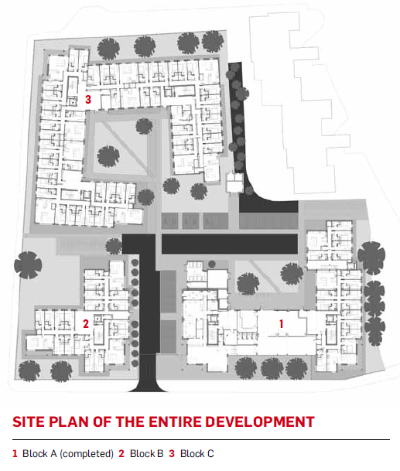
The architects were keen that the development should not give a monolithic definition to the street. Instead, they are creating a rhythm of three towers containing the cores along Denmark Road with lower scale L-shaped blocks of bedrooms in between, arranged in clusters of four and five bedrooms around communal living, dining and kitchen areas. To the rear is a courtyard. Behind, on Burleigh Street, is a further block, configured to contain its own courtyard. Students enter either from Denmark Road or to the rear through the corners of these private courtyards. The ground floor also contains a general common room for the whole block plus a laundry, WCs, and offices for the block managers.
“There was a desire to think about how it engaged with the street and courtyard, and how we could create intimacy within a very large development,” says Hodder. “What could have been a really overpowering block of student accommodation is now broken down into smaller elements.”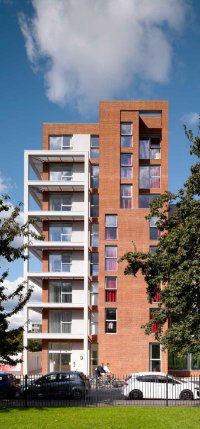
The first phase contains 246, 5m x 2.7m study bedrooms and bathroom units. The two further phases will follow by September 2013.
Both the design and construction of Ducie Court were fast track, with the building designed and on-site within three months – three times faster than usual. According to Peter Ward of Fairhurst, this was only possible because the architect and engineer worked simultaneously rather than consecutively, and because of the contractor-client’s drive to be finished in time for the autumn intake.
“It was a phenomenal feat of construction by the contractor to provide a simple but quality building,” he says. “It’s a relatively simple building, built to last.” Hodder adds: “Putting up [nearly] 400 tonnes of steel frame in six weeks is absolutely extraordinary.”
Time was the main challenge according to Bolton-based steelwork contractor BD Structures. “A lead in time of just five to six weeks is very quick for the size of the project,” says BD Structures managing director Chris Heys. “Fairhurst provided very good information to us and that helped us deliver so quickly.”
The structure is a relatively straightforward main steel frame without concrete sheer walls, fully-diagonally braced and with a composite metal deck floor. There was more complexity in reconciling the different tolerances of the steel frame and the brick skin. Apertures were pre-cut in the steel and stiffened accordingly to enable the distribution of services throughout the building.
“Most of our schemes are built in steel,” says Russell Worthington, development director of developer Worthington Properties. “Concrete is far too slow. Steel frame is all to do with speed.”
Corners
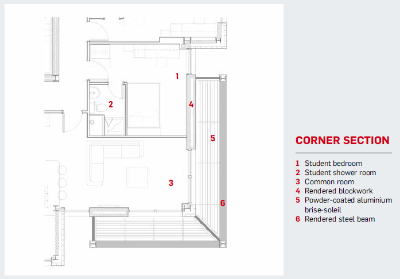
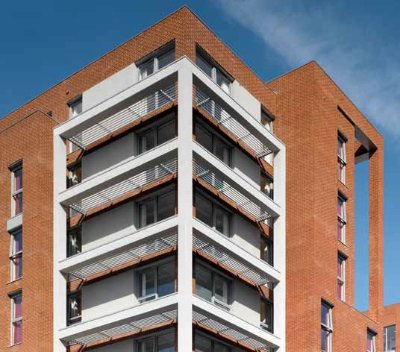
“The corners of the high-rise blocks are the giveaway that it’s a steel–framed construction,” says Hodder. These hold the common rooms, fully glazed to make the most of the park aspect and set back 1.5m with brise soleils to mitigate solar gain. The beams are the only part of the structure not clad in brick – here it was felt that it was more structurally honest, says Hodder, to use render, in conjunction with the brick-clad steel piers. On the upper levels of the towers are 12m-high feature columns, constructed in one piece by BD Structures, which pick up the projecting roof. These are H-shaped in section, and clad in a brick square box.