
The Stage, Shoreditch, London
Steel takes to the stage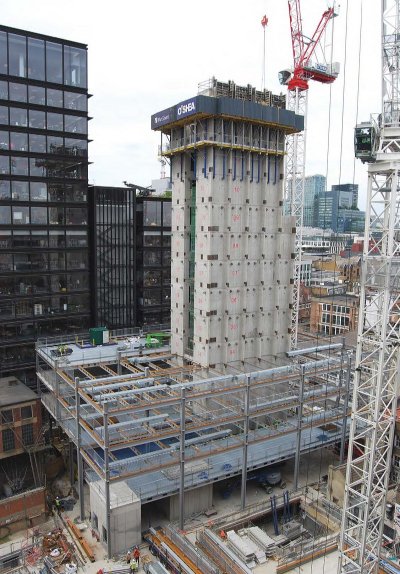
By Martin Cooper
All the world’s a stage’ wrote William Shakespeare and whether one agrees with this or not, one area of Shoreditch is now very much a stage. Located in an area that is not immediately associated with dramatics – being a few miles east of the capital’s main theatre-land in the West End – The Stage development in Shoreditch is named in honour and shares a site with the remains of the Curtain Theatre (see below).
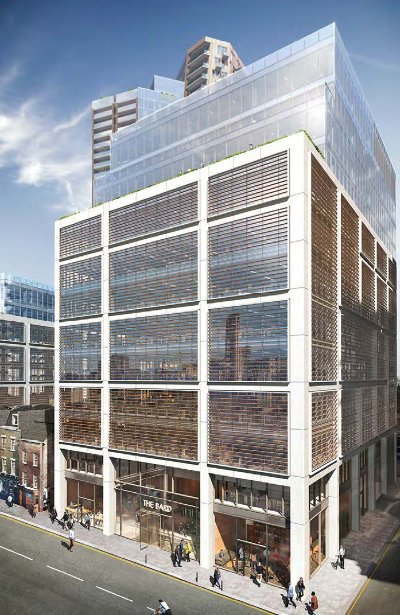
During its heyday, the Curtain is said to have been the venue where Shakespeare’s Henry V debuted, and as a nod to the playwright, one of the scheme’s commercial blocks (Building 3) has been named The Bard. This is one of two office blocks within The Stage development, the other being a smaller concrete-framed structure named The Hewett. Situated between these two buildings is the main archaeological plot where a museum is going to be built to display artefacts found on the site. The Stage’s other structures include a 37-storey residential block, restaurants and an art gallery housed within a former railway viaduct.
The Bard is a 12-storey steel-framed block, which will provide 12,700m2 of contemporary offices along with large west-facing terraces. Working on behalf of main contractor CJ O’Shea, SDM Fabrication is fabricating and erecting just over 1,200t of structural steelwork for the project. “Logistics is the biggest challenge on the project, as we have a number of buildings under construction at once and just one entrance serving the site,” says CJ O’Shea Project Director Fintan Hallihan. “The advantage of using steelwork for The Bard is that all material is delivered on a just-in-time basis as there is no room for storage.”
The building has a composite design, with steel beams supporting metal deck flooring and a concrete topping. Composite Profiles is supplying 15,000m2 of Tata Steel’s ComFlor 51 for the project along with 45,000 shear studs.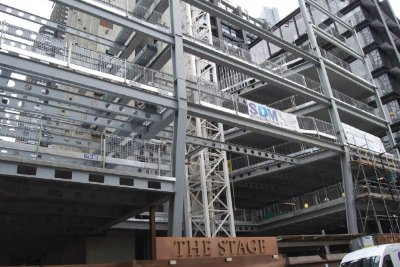
“In order to maintain the same floor-to-ceiling heights throughout the building, the deeper transfer beams are installed within the depth of the concrete slab,” explains Mr Modarres. A further transfer structure has been installed along the second floor’s eastern elevation. The beam forms an overhang, which is necessitated by the proximity of an existing electricity sub-station.
The Stage development is scheduled for completion in November 2021.
History unearthed and preserved
Archaeological discoveries on central London construction sites are not uncommon, but finding a long-lost Elizabethan playhouse where Shakespeare’s Romeo & Juliet and Henry V were first performed is a one-off occurrence. Known as the Curtain Theatre, the playhouse was built in 1577 just outside of the City of London in Shoreditch. It was one of the capital’s premier theatres and William Shakespeare is even said to have trod the boards there himself. History is a little sketchy on its fate, but it is believed that it closed down in the 1620s and was converted into tenements before being demolished and its exact location forgotten.
Jump forward to 2011 and preliminary works for this project unearthed remnants of a stage, the playhouse’s walls and foundations along with numerous Elizabethan artefacts. Preserving this slice of theatrical history is going to form an important element of the Stage development. The Curtain Theatre finds are being preserved and will be put on public display within a museum structure (likely to be steel-framed) which will sit next to the Bard building in the project’s central plaza.