
No.1 Spinningfields, Manchester
Steel creates office landmark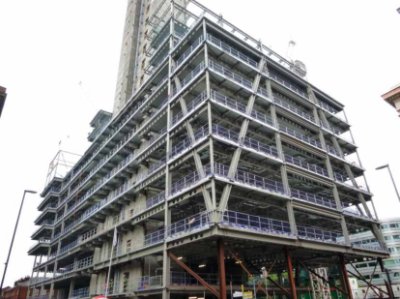
By Martin Cooper
Forming the final element of the Spinningfields masterplan, a grandiose scheme that has created a new business district in central Manchester, No. 1 Spinningfields will deliver 32,000m2 of Grade A office accommodation providing high quality space to a range of occupiers. What is more, topping out at 20-storeys high the building will not only be one of the highest structures in Manchester, it will claim the accolade for the city’s tallest office block built in the last 50 years.
The project will also act as an anchor to the Spinningfields development and as such a standout design will be achieved via three cantilevering façades and a fully-glazed exterior. Located on an island site surrounded by roads on three sides and a pedestrianised zone on the fourth, the cantilevers act as highly visible architectural features on what would otherwise be a standard cityscape.
Work on the project began in July 2015 and early works included deepening the basement left over from the previous building from one to two levels. The lowest basement level (level -2) is formed with concrete and the main steel frame of the building kicks-off from basement level -1.
Although the project is structurally one large building it is a steel-framed structure with two distinct parts. Each with their own concrete core, one section extends up to the full 20-storey height, while the western portion of the building tops out at nine-storeys. At ground floor level these two parts are separated by a pedestrian walkway that cuts through the building creating a shortcut between Quay Street on the south and Hardman Square to the north.
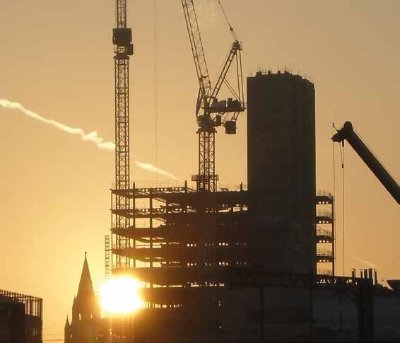
Steelwork contractor William Hare has used Fabsec cellular beams throughout the building for service integration within the structural void.
The most complex part of the structure’s steel frame is the eastern cantilever which, as well as creating an architectural highlight for the building, also creates a canopy over the main entrance. The deepest of the building’s cantilevers, this feature element is 7.5m-deep and extends from level 1 up to the underside of level 7, thereby incorporating six floors.
A large six-storey Vierendeel truss positioned along the cantilevers façade forms and supports this feature element. The outer corners of the truss are supported by two V-shaped nodes, each weighting 19t, that not only connect with the first floor beams and the truss, but also a feature vertical CHS column that frames the elevation. “However, the cantilever is so deep that extra supports are required in the form of two plane trusses positioned at level 1 and the underside of level 7, that support the Vierendeel and are braced back to the main tower’s core,” says Mr Smith. This forms a kind of structural sandwich with the six floors of the cantilever positioned between the trusses.
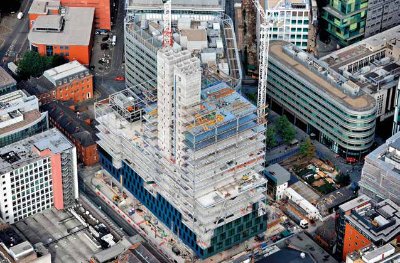
No.1 Spinningfields is scheduled to be complete by mid-2017