
Brunel Building, Paddington, London
A nod to an engineer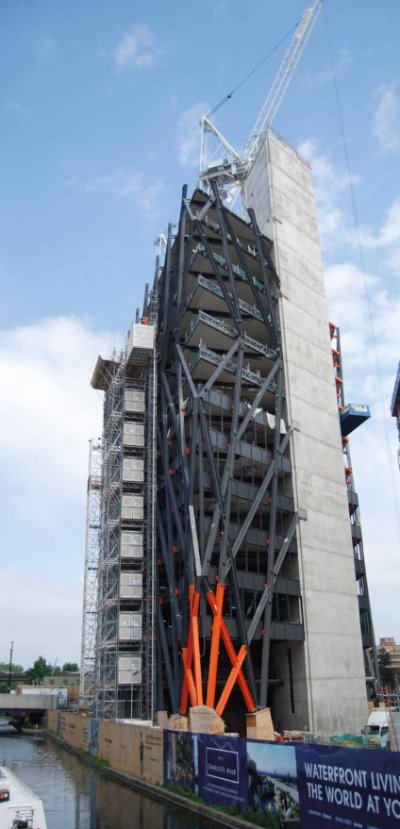
By Martin Cooper
Overlooking the Grand Union Canal opposite Paddington Station, an innovative new workplace, which offers up more than a passing nod to the famous builder of the rail terminus, is taking shape.
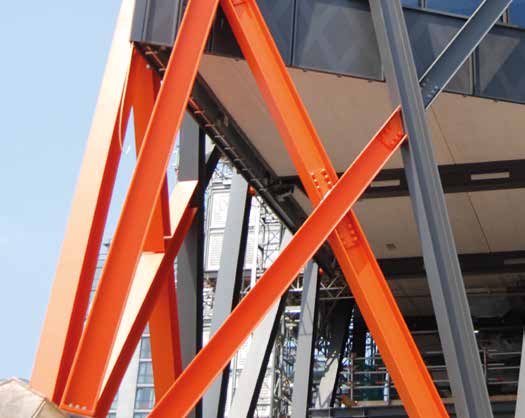
Named in honour of Isambard Kingdom Brunel, the Brunel Building would undoubtedly have delighted the famous engineer with its exposed engineered steelwork and multiple connections, which sits perfectly next to his giant iron-framed station shed. Together with exposed steelwork, the industrial palette of the building also includes exposed concrete flooring and cores as well as service runs, accommodated within cellular beams, all left in full view. “As well as offering recognition to Brunel, as his first-ever bridge was once located on the northern boundary of our site, the steel design has enabled us to express the structure in a contemporary way and create the desired clear internal spans,” says Fletcher Priest Architects’ Senior Project Architect Chris Radley.
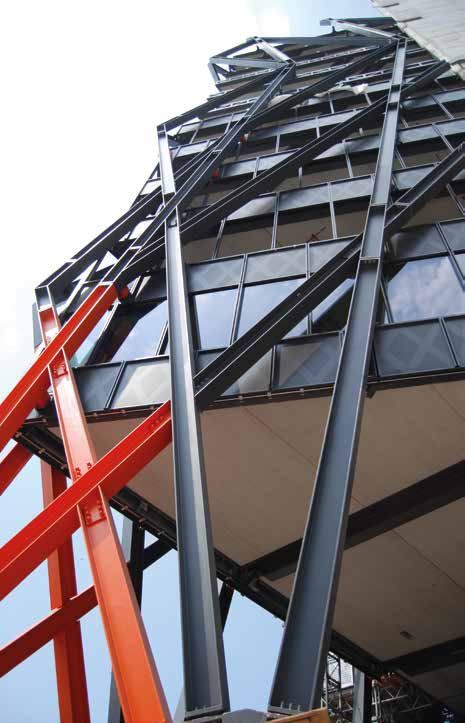
The scheme has been in the offing for nearly 14 years, but finally started to come out of the ground last year once Laing O’Rourke had been awarded the contract by Derwent London. The design had always envisaged a stand-out commercial building, one that would make people stop and look up, and that is exactly what is now being delivered. Topping out at 17-storeys high, the building’s most visually exciting component is its exoskeleton that sits in front of the cladding and allows the structure to have continuous glazing to all facades. The glazing will offer the occupiers, especially those on higher floors, some spectacular views of London, while the exoskeleton will provide solar shading.
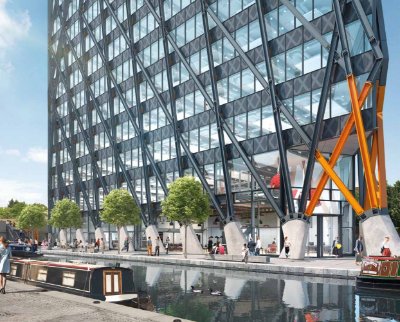
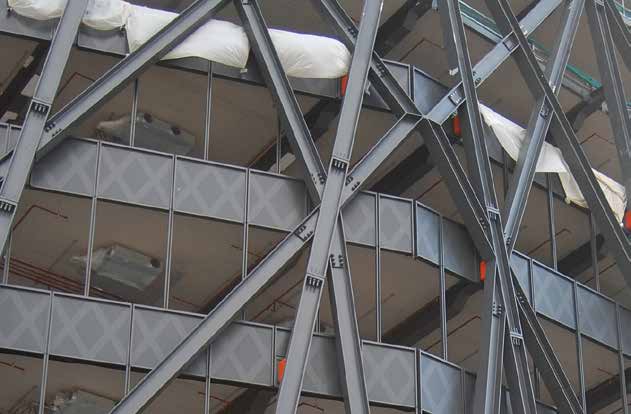
“The skeleton is an architectural feature as it supports vertical loads, but does not contribute to the overall lateral stability of the building as this is done by three cores,” explains Arup Engineer Steve Peet. “There are longitudinal forces generated and these are taken back to the cores, but generally the less steep elements are all non-structural, acting as bracing while the steel is being erected.”
A series of Fabsec cellular beams connects the exterior skeleton frame to the three centrally-positioned concrete cores. As the building splays outwards on plan, the eastern end of the structure has column-free spans of 6m, but this increases substantially to 18m-long clear spans, either side of the core at the western end. “Because the steelwork is left exposed as a feature element, the cellular beams have bespoke ‘wishbone’ connections to the core and exoskeleton,” says Severfield Senior Project Manager Andy Luter. “They taper down from 650mm-deep sections to 350mm in order to minimise the penetration through the cladding as well as providing aesthetically pleasing steelwork.”
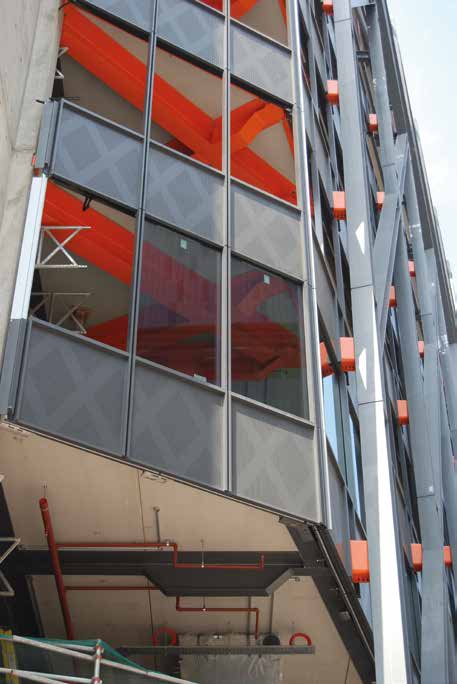
Forming the floors of the building, the Fabsec cellular beams support precast panels, all of which have been installed by Severfield along with the steelwork. They have a highly architectural polished finish to their undersides as this part will be left exposed in the final scheme, while on top, a concrete topping is applied to form the floor.
Prior to the topping being applied the panels would ordinarily need to be propped as they would not be stable. However, on this scheme, most of the temporary props have been dispensed with as the panels have a steel torsional restraint which provides rigidity during the temporary state. The restraint is a steel beam fixed to the underside of each panel, which is removed once the floor has been cast. Either end of the panel has a steel plate that connects to the adjoining panel, and these are cast-in and hidden from view once the floor is complete.
Severfield’s programme involved erecting three floors of steelwork before using the same tower cranes to install the concrete floor panels, by lifting them carefully down through the steel members. The site’s two tower cranes are positioned in voids either side of the main central core and the two outer cores. These areas, which measure up to 8m-wide, will be infilled by Severfield during a return visit once the cranes are no longer needed and dismantled. “Coordination has been key to the success of this project,” explains Laing O’Rourke Project Manager Craig Stokes. “Severfield has had to work closely with our offsite precast panel production to install the steel restraints prior to them being delivered to site.”
Steelwork starts at ground level and is founded on a concrete substructure encompassing a two-level basement. This has been formed by a combination of raft foundations, a secant wall up to 25m-deep and a concrete capping beam. “The secant wall and the raft have to work in conjunction as in one corner of the building the proximity of the Bakerloo Underground Line meant no deep piles could be installed,” explains Mr Peet.
The Brunel Building is due to be completed during 2019.
Exoskeletons in buildings
The Brunel Building adopts an exoskeleton. Richard Henderson of the SCI discusses the structure.
Another example of a building with an exoskeleton in London is Bush Lane House by Arup Associates in which the external diamond lattice structure transfers vertical loads to the main vertical columns and shares in resisting the lateral loads on the building in one of the orthogonal directions. A particular feature of the external structure in Bush Lane House is that the external bracing is of stainless steel and is water filled to provide fire protection. The external structure therefore has several different functions.
The exoskeleton of the Brunel Building is an architectural feature which supports vertical loads but does not resist lateral loads, thus not fully exploiting the available structure. The lateral stability of the building is provided by three substantial concrete cores. The absence of stiffeners in the connection details between the less-steeply inclined elements and the steeper ones in the exposed frame confirms that the forces in the former elements are not significant.