
Structural Steel Design Awards 2009 - Winner
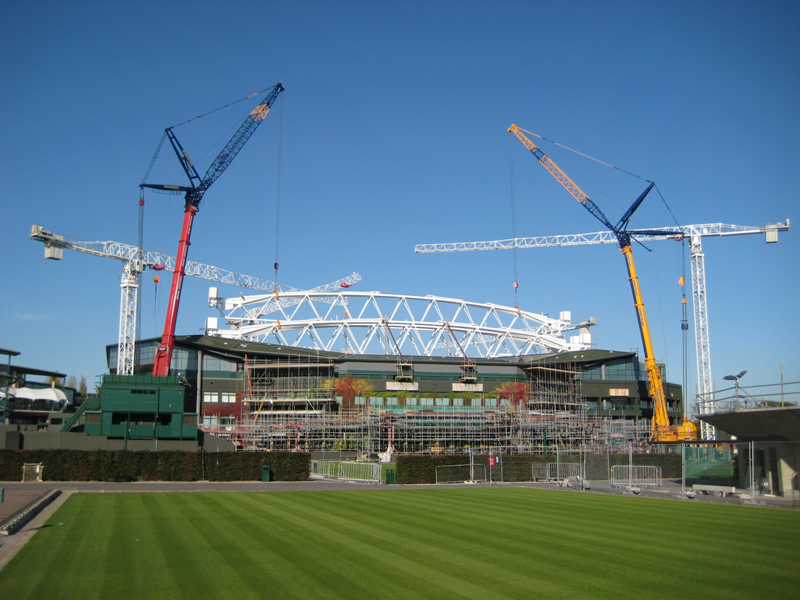
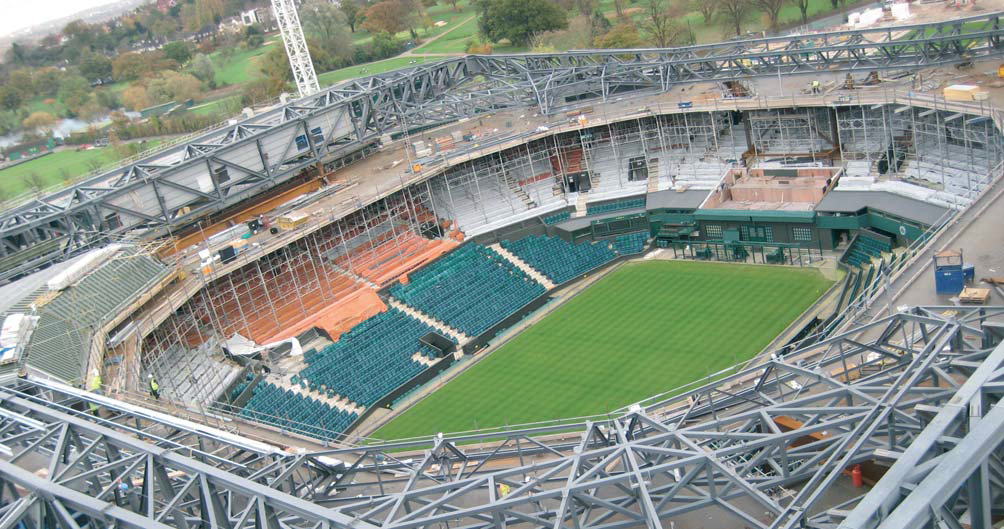
The fixed part of the new roof has a similar structural form to the old roof in that it consists of four main trusses spanning between four 'supercolumns' located at the corners of the stadium, with a series of cantilever trusses supported at the perimeter of the stadium and extending inwards towards the centre of the court. The main difference between the old roof and the new is that the new roof not only has to span further over the extended seating, but also has to support the new retractable roof and the air conditioning plant and ducting housed within.
The retractable roof alone weighs 1,100 tonnes and the air conditioning plant adds another 400 tonnes. This means that the four main trusses spanning between the columns have to be very substantial not only in terms of strength, but also in terms of stiffness to limit deflections when the retractable roof is deployed. The total weight of structural steelwork in the fixed part of the roof is approximately 1,700 tonnes.
With the total all up weight including cladding, plant and the retractable roof, the maximum load transmitted to the two northern columns is just over 1,200 tonnes. However, the 'supercolumns' in the south elevation take a lot less load than those in the north since they share the weight of the southern truss with two neighbouring columns on the front elevation which supported the old roof. This means that the two exposed columns on the south elevation take maximum loads in the order of 700 tonnes and are thus designed to be more slender and elegant.
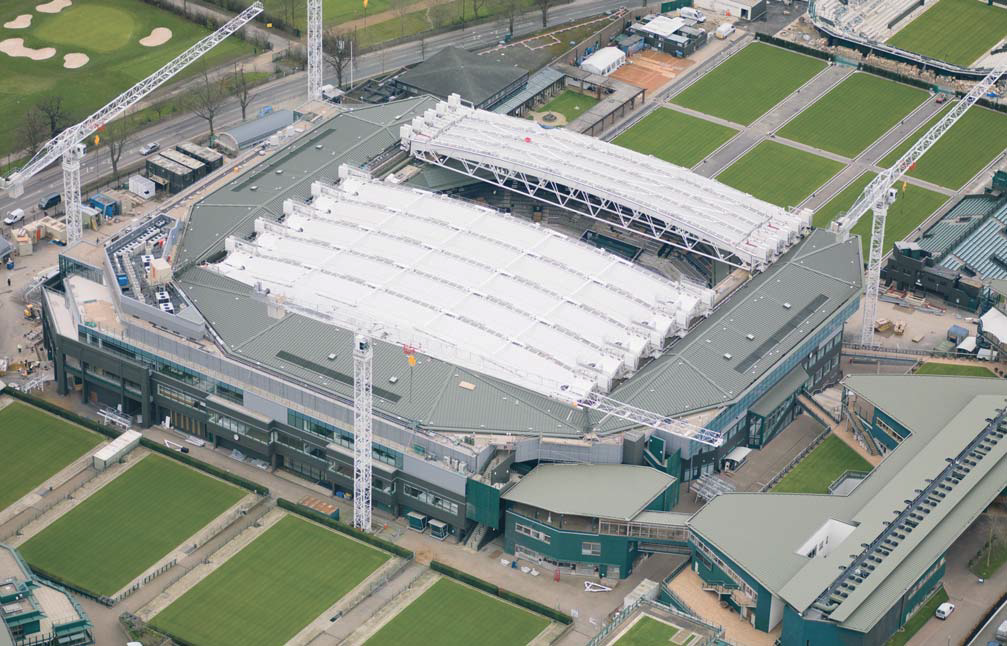
Steel trusses span approximately 77m across the court and rise to a maximum of nearly 6m above the fixed roof eaves line. The trusses are supported at each end by a wheel set (bogies) consisting of four wheels (for stability) which move on tracks connected to the fixed roof. The bogies are driven by electric motors and, when the roof is required to be deployed (after one section has been moved to the south), the trusses unfold the fabric by being moved primarily by the use of these driven bogies but also by synchronised electro-mechanical actuators, which help open and stabilise the hinged 'arms' at the ends of the trusses. At the same time as the fabric is being unfolded by the hinged arms there are restraint arms in four lines on top of each truss and fabric bay, and these help to push and keep the trusses apart and, again, these arms are also operated by electro-mechanical actuators.
Moving the southern section of the roof from its parked position in the north to its position in the south will take approximately 20 minutes. Deploying the roof over the court from this position will take under 10 minutes, the actual time being dependent on detailed considerations including safety.
In its fully parked and fully deployed positions the roof is designed to sustain the maximum design wind and snow loads which are approximately equivalent to two people per square metre on the roof. The roof is designed to be operated (parked or deployed) in wind speeds up to 25m per second, roughly 55 mph.
|
'Architect' |
Populous |
|
'Lead Concept Designer including structural concept design' |
Bianchi Moreley Ltd |
|
'Structural Engineer' |
Capita Symonds |
|
'Detail Structural Coordinator' |
Edge Structures |
|
'Steelwork Contractor' |
Watson Steel Structures Ltd |
|
'Main Contractor' |
Galliford Try |
|
'Client' |
All England Lawn Tennis Club (AELTC) |
Judges' comments
Overcoming the challenges of design, programming and logistics over a 3-year period, has ensured minimal disruption to the Championships. The main 1100 tonne retractable roof uses structural steel to its full advantages, with skilful marriage of heavy precision engineering and state-of-the-art technology, to achieve the all-weather operations so long desired.
This project exemplifies quality, integrated team working.